 MochiSim
October 3, 2026
Osaka Travel Guide: Food, Neighbourhoods and Day Trips
Three days is enough for a first visit to Osaka, and it leaves room for one day trip. Base yourself near Namba or Umeda, spend your evenings eating, and use the trains to reach Nara and Kobe.
Osaka is a compact, flat, food-obsessed city where the main areas sit a few subway stops apart. That makes it easy to plan by neighbourhood rather than by sight, and to mix a castle morning with a very serious dinner.
How many days do you need in Osaka?
Three days works well for a first trip: one for Namba and Dotonbori, one for Osaka Castle and Umeda, one for Shinsekai and whatever is left on your list. Two days covers the highlights if you are hurrying. Add a fourth day if you want a day trip without giving up a food evening.
A simple split that holds up in practice:
- Day one: Namba, Dotonbori and Shinsaibashi shopping.
- Day two: Osaka Castle in the morning, Umeda in the afternoon.
- Day three: Shinsekai, then a lazy afternoon or an early start for a day trip.
What are the best neighbourhoods in Osaka?
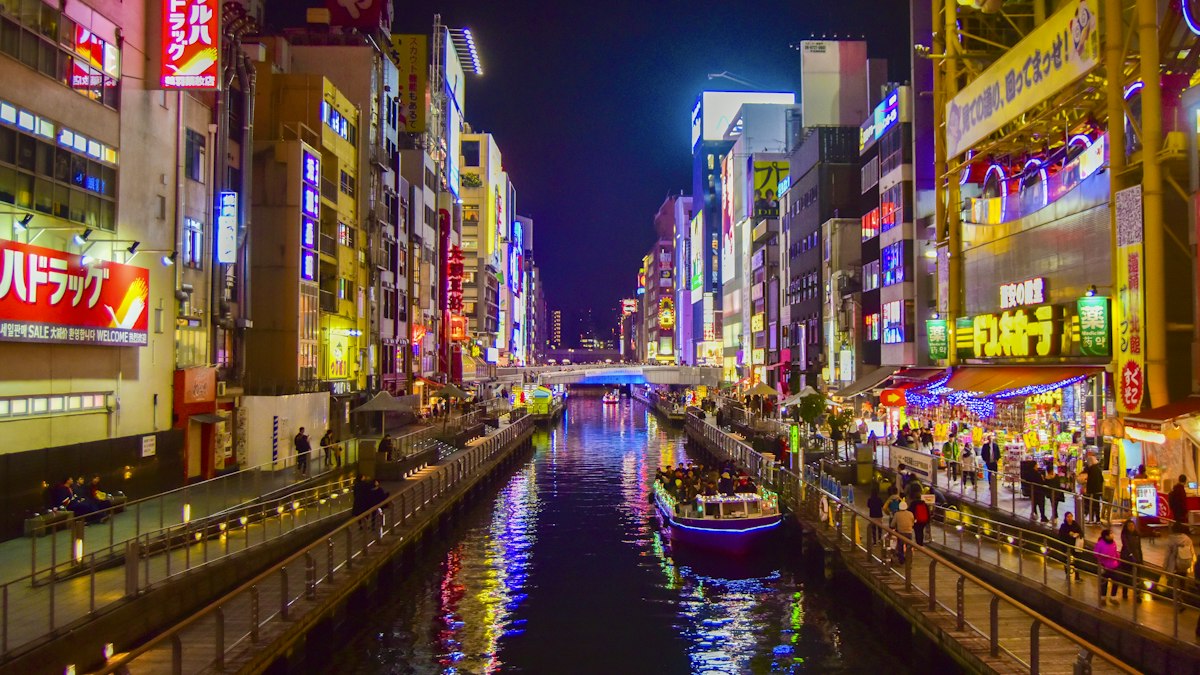
Namba and Dotonbori are the loud, bright centre: the canal, the neon signs, the Glico running man, and the densest concentration of restaurants in the city. The covered arcades of Shinsaibashi and Kuromon Ichiba market are close by. It is busy at night, which is the point.
Umeda is the main rail hub, where the JR, Hankyu and Hanshin stations meet, surrounded by big shopping complexes. It suits travellers who plan to leave the city often.
Shinsekai is older and rougher around the edges, with Tsutenkaku Tower looming over cheap, unfussy eateries. It feels less polished than Namba, which many people prefer.
Osaka Castle sits on its own in a park to the east. Go early, ideally before the tour groups arrive, and keep it to a morning.
What should you eat in Osaka?
Eat takoyaki, okonomiyaki and kushikatsu, in roughly that order of how often you will see them.
- Takoyaki: octopus dumplings from a griddle, sold at street stalls and small shops, served very hot. Wait a minute before biting.
- Okonomiyaki: a savoury pancake with cabbage and your choice of fillings, often cooked on a hot plate at your table.
- Kushikatsu: deep-fried skewers, best eaten in Shinsekai where it started. Many shops there have English menus. Do not double-dip your skewer in the shared sauce; use the cabbage to scoop it instead.
Dotonbori is the obvious place to graze in the evening. For a calmer meal, Shinsekai is more relaxed, and Umeda has plenty of quieter restaurants if you want to sit down properly.
Is Nara an easy day trip from Osaka?
Yes. You have two real choices.
The JR Yamatoji Line runs from Osaka Station, or from JR Namba, to JR Nara Station in roughly 50 minutes, depending on the service. From Namba some services are direct and others need a change, usually at Kyuhoji. The Kintetsu Nara Line runs from Osaka Namba to Kintetsu Nara Station in about 35 to 40 minutes on the faster services, and the limited express needs a separate ticket.
The practical difference is location. Kintetsu Nara Station is a short walk from Nara Park and its deer, while JR Nara Station is a longer walk. If you hold a Japan Rail Pass, only the JR line is covered. Check current timetables and fares with the operator before you go, as services change.
A half day is enough for the park and the main temple. Pair it with an evening back in Osaka.
Is Kobe worth a day trip from Osaka?
Yes, as a half day or an evening, and it is the quicker of the two. The JR Kobe Line Special Rapid Service takes about 20 minutes from Osaka Station to Sannomiya. Hankyu from Osaka-Umeda takes about half an hour, and Hanshin is similar. The three Sannomiya stations are separate, so check which one is nearest to where you are heading. Only the JR line is covered by a Japan Rail Pass.
Kobe suits a gentler pace: the hillside district of Kitano with its Western-style merchant houses, the waterfront at Harborland, Meriken Park and the Kobe Port Tower. Kobe beef is the famous order, though Osaka does takoyaki, okonomiyaki and kushikatsu better, so keep those for home turf. Opening hours for the ropeway and the tower vary by season and day, so confirm them before you plan around an evening visit.
Where should you stay in Osaka?
Namba is the easiest all-round choice for first-timers: central, lively, and close to the airport line. Expect busy streets at night, so check the room's position if you sleep lightly. Umeda is better if you want fast rail links and a calmer evening. Shinsekai is generally the cheapest part of central Osaka and has a retro feel, though it is less polished.
Whichever you pick, stay within a few minutes of a station. In Osaka the train is the neighbourhood.
How do you stay connected in Osaka with an eSIM?
Maps, translation and train apps all need data, and you will use them constantly when hopping between stations. Before you travel, run through this checklist:
- Your phone supports eSIM.
- Your phone is unlocked from its carrier.
- Your software is fully updated.
Travelling to Japan?
- 3 GB per day · 1 day€5.90
- 3 GB per day · 3 days€7.90
- 1 GB per day · 7 days€8.10
Install the eSIM before you leave, ideally on home Wi-Fi, then switch it on after landing. A MochiSim eSIM is data only, with no phone number, calls or SMS, so keep your home SIM active as the second line for texts and verification codes, and set the travel eSIM as your mobile data line. That dual-SIM setup lets you use maps and apps in Osaka without losing your usual number.
Travelling to Japan?
Get an eSIM with instant data and land already connected.
Stay connected wherever you travel
Instant eSIM data plans, wherever you're going. No physical SIM, no roaming surprises.